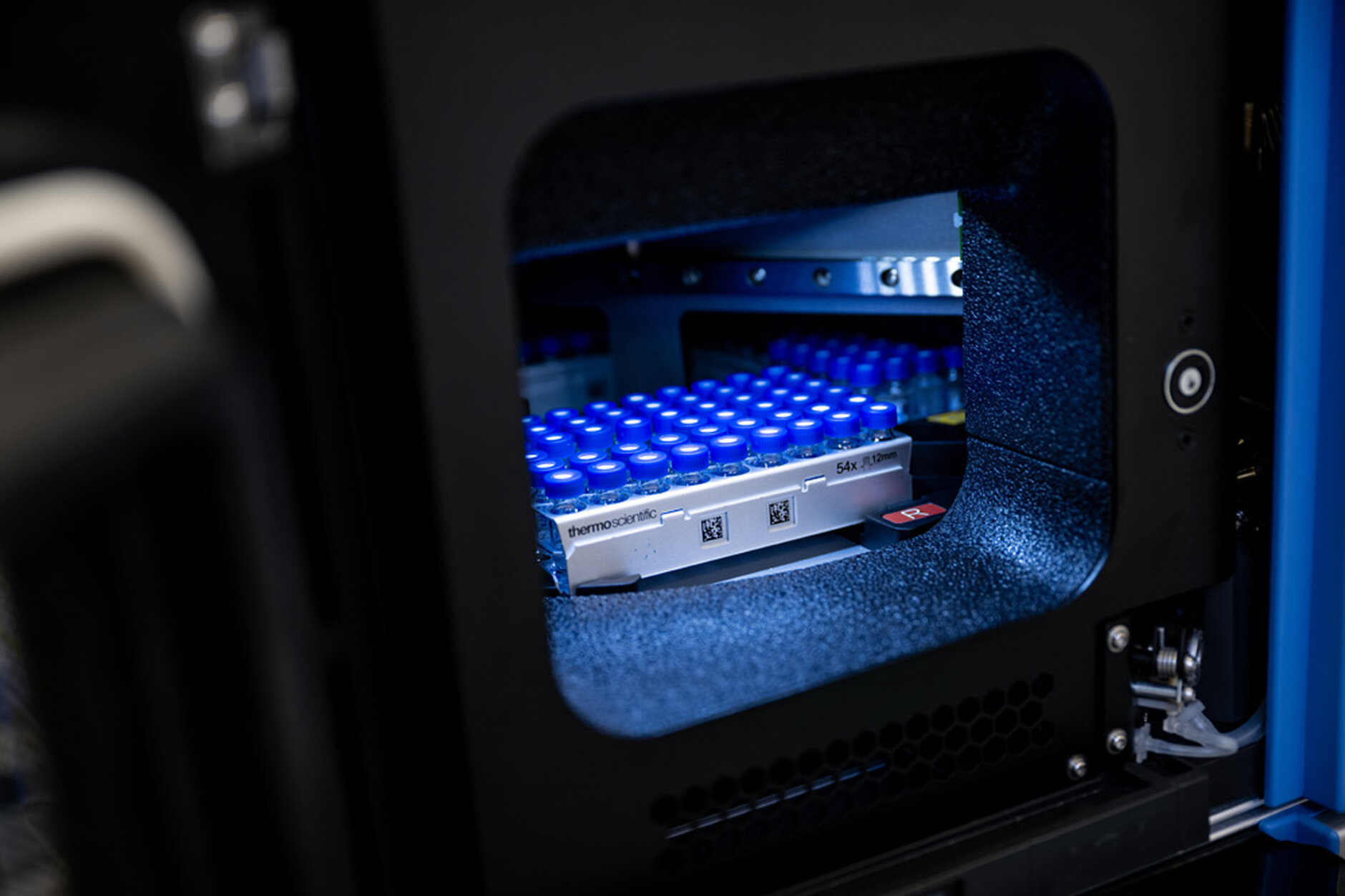
Nanoflow LC-MS combines liquid chromatography with mass spectrometry at flow rates measured in nanoliters per minute. Running at this scale improves ionization and helps characterize low-level components, even in small or highly complex samples. In biopharmaceutical development, that means low-abundance protein variants, post-translational modifications, degradation products, and process-related impurities that conventional-flow LC-MS can miss. The technology is therefore most useful when sensitivity or sample availability becomes a real limitation, rather than as a routine choice for every analysis.
Its strongest value often appears in host cell protein (HCP) and residual protein analysis, and in peptide mapping. It is not generally positioned as a routine quality control platform, and its higher sensitivity must be balanced against method robustness, transferability, and regulatory expectations. This article explains how nanoflow LC-MS works, where it adds value, and when a conventional method is the better choice.
Why LC-MS is important in biopharmaceutical characterization
A biologic does not exist as one perfectly uniform molecular population. Manufacturing, purification, storage, and handling can all introduce small differences. This is especially relevant for therapeutic antibodies, fusion proteins, antibody-drug conjugates, biosimilars, and other complex protein modalities. Not every change is important, but certain differences can alter stability, biological activity and even safety. LC-MS shows these changes in detail: it can confirm the amino acid sequence, show where post-translational modifications are present, and detect impurities and degradation products or other structural differences.
Residual protein and host cell protein testing presents another challenge: hundreds of proteins at very different concentrations, where low-level impurities can hide behind more abundant components. High-resolution LC-MS provides the selectivity needed to investigate them. For this reason, LC-MS supports development, process studies, comparability exercises, and regulatory documentation.
Broader strategies for biopharmaceuticals analytical testing are discussed in a separate article.

What is nanoflow LC-MS?
Nanoflow LC-MS couples nano liquid chromatography on narrow-bore columns, typically around 75 µm inner diameter, with mass spectrometry through a nano-electrospray source. The low flow produces smaller droplets that desolvate more efficiently, so a larger share of the analyte reaches the mass spectrometer as ions. The result is a stronger signal from less material. That sensitivity makes nanoflow LC well suited to detailed characterization: detecting trace impurities, minor peptides, and low-level modifications in early-development or residual protein samples.
Nanoflow LC-MS versus conventional LC-MS
Conventional LC-MS is still the preferred option for many routine analyses. The systems are generally more robust, methods are easier to transfer, and sample throughput is higher. Higher flow rates also make day-to-day operation more straightforward and reduce the chance of disruption during long analytical runs.
Nanoflow LC-MS serves a different purpose. Its lower flow rates improve sensitivity and reduce sample consumption, which is useful when material is limited or when low-abundance species must be measured in a complex background. The trade-off is greater method complexity. Nano systems often require tighter control of connections, column performance, spray stability, and sample preparation.
Routine release testing usually favors conventional LC-MS because speed, reproducibility, and operational simplicity carry more weight. Neither approach is universally better: the choice depends on the analytical question, the amount of sample available, and the stage of development.
Key applications of nanoflow LC-MS in biopharmaceutical analysis
Nanoflow LC-MS is most valuable when sensitivity, sample conservation, or deeper structural detail is needed during biopharmaceutical characterization.
Host cell protein and residual protein analysis
Host cell protein and residual protein analysis is one of the clearest high-value applications of nanoflow LC-MS in biopharmaceutical development. The therapeutic protein may dominate the sample while individual HCPs are present at trace levels, creating a wide dynamic range that makes low-abundance impurities difficult to detect. The sensitivity of nanoLC-MS can improve the identification of these proteins and provide impurity-specific information that complements total-HCP measurements. Because less material is required, HCP clearance can also be assessed on early or intermediate process samples.
Peptide mapping
Peptide mapping LC-MS is another important application. NanoLC-MS can support sequence confirmation, detection of sequence variants, and localization of post-translational or chemical modifications at the peptide level. As with HCP analysis, its low sample requirement lets peptide mapping start on small amounts of early-stage or intermediate material, giving earlier structural information to support product understanding, process investigations, and comparability assessments.
Post-translational modifications and low-abundance variants
Nanoflow LC-MS can examine oxidation, deamidation, glycosylation, clipping, truncation, and many other post-translational modifications, as well as low-level variants and impurities. Some of these occur at low levels but may still be relevant to product quality, stability, activity or safety, depending on their location, abundance and effect on molecular function. Higher sensitivity helps bring these minor forms into view, particularly in complex samples during process optimization and comparability studies.
ADC characterization
Antibody-drug conjugates combine antibody structure, linker chemistry, drug load, and a distribution of conjugated species. Nanoflow LC-MS can support peptide-level characterization, site-specific analysis, identification of drug-conjugated peptides, and detection of low-level variants. It remains one option within a broader analytical toolbox and is not required for every ADC program.

Advantages of nanoflow LC-MS
Nanoflow LC-MS offers two practical advantages: greater sensitivity and lower sample consumption. Sensitivity matters most in high-dynamic-range samples, such as the HCP analyses described above, where trace impurities sit next to an abundant therapeutic protein.
Lower sample demand can also influence development timelines. Intermediate batches may contain enough material for nanoLC-MS analysis earlier than they would for a method requiring a larger sample allocation. This gives development teams earlier access to characterization data and can support timely process decisions, even though nanoLC-MS run times may be longer than those of higher-flow methods.
Practical considerations and limitations
Nanoflow LC-MS can generate highly detailed data, but it is more demanding to run on a routine basis. Performance can shift with small changes in tubing, fittings, column packing, or spray stability, so careful system setup and close monitoring are essential. Run times are often longer, and throughput is lower than with conventional LC-MS. Reliable operation also depends on staff with specific technical experience.
Method transfer can be difficult when instruments, columns, or source configurations differ between sites. Robustness therefore has to be demonstrated carefully before the method is used in a regulated setting.
Regulatory relevance and lifecycle considerations
Nanoflow LC-MS can strengthen product understanding during development by providing detailed information on structural variants, impurities, and process-related changes. The resulting data can support comparability studies, process development, and the scientific justification included in regulatory submissions.
Use in a regulated environment requires a clear validation strategy, demonstrated robustness and transferability, and long-term lifecycle control. These expectations remain the main bottleneck for broader nanoLC adoption, even as biopharma demand for greater sensitivity from limited or complex samples continues to grow.
Detailed guidance on method validation and lifecycle management is provided in a related article.
Strategic role of nanoflow LC-MS in biopharmaceutical development
Nanoflow LC-MS is most useful when it is built into a wider analytical program. It can provide a more extensive look at product variants, complex protein structures, and changes that may matter during comparability studies. The technique is often brought in when routine methods leave an important question unresolved or when sample availability is limited.
These data can do more than describe the sample. They can help shape process development, support change assessments, and show whether a product difference is likely to matter.
At Anabiotec, we build fit-for-purpose analytical strategies around the product, the available sample and the specific CMC question. We use nanoflow LC-MS where its sensitivity adds real value, and choose more robust or higher-throughput techniques where they better serve the development objective.
Connect with our experts
Working with limited sample material or investigating low-abundance proteins and variants? Our experts help determine where nanoflow LC-MS can add value within your biopharmaceutical characterization strategy.
From host cell protein analysis and peptide mapping to comparability questions, we align the analytical approach with your product, development stage and specific CMC needs.
Get in touch to discuss your analytical question and the right balance between sensitivity, sample use and method robustness.
Frequently asked questions
What is the difference between nano LC and conventional LC-MS?
Nano LC uses lower flow rates and less sample. Conventional LC-MS is usually more robust, requires less hands-on experience from the operator, and supports higher throughput.
When is nanoflow LC-MS used in biologics characterization?
Nanoflow LC-MS is often chosen when only a limited amount of sample is available or when the sample contains many components at very divergent concentrations. Typical uses include host cell protein analysis, residual protein testing, and peptide mapping.
Can nanoflow LC-MS be used for ADC characterization?
Yes. It can help examine drug-linked peptides, conjugation sites, and low-level product variants at the peptide level. The method is usually used alongside other analytical techniques rather than as the only tool for ADC characterization.
What are the advantages of nanoflow HPLC?
Nanoflow HPLC can improve sensitivity and reduce sample use. These benefits matter most in complex samples with a large dynamic range.
Is nanoflow LC-MS suitable for routine QC?
Not usually. Lower throughput, longer runs, and demanding system setup often make it better suited to advanced characterization.

